Responding to chemical spills. Optional module — practical response to fire emergencies.
We help employees at manufacturing plants and warehouses prepare to respond to chemical spills. We combine an explanation of response principles with exercises tailored to the conditions at your facility.
Safety comes first: recognising hazards, raising the alarm and assessing when it is safe to act and when to withdraw and call for help.
The training is intended for companies that use or store chemicals and for employees who are expected to take part in responding to emergencies.
Consider arranging it when:
The programme takes account of participants’ responsibilities and the hazards present at the facility.
If a chemical agent present in the workplace poses a risk of an accident or emergency, the employer should implement procedures that also include periodically repeated rescue exercises. This obligation arises from § 11 of the Polish Minister of Health’s Regulation of 30 December 2004 on occupational health and safety related to the presence of chemical agents in the workplace (consolidated text: Journal of Laws of 2025, item 836, as amended).
Training with exercises tailored to the facility’s hazards and procedures can form part of fulfilling this obligation. It does not replace the development of procedures or the provision of appropriate equipment and emergency response arrangements.
The training supports the implementation of the requirements of environmental management systems based on ISO 14001 and occupational health and safety management systems based on ISO 45001 in the areas of emergency preparedness and response, and employee awareness. The exercises help test established response arrangements in practice, reinforce participants’ roles and identify areas for improvement.
We tailor the scope of the training to the hazards and arrangements at the facility. Participation in the training does not, on its own, confirm the conformity of the entire management system.
The scope covers:
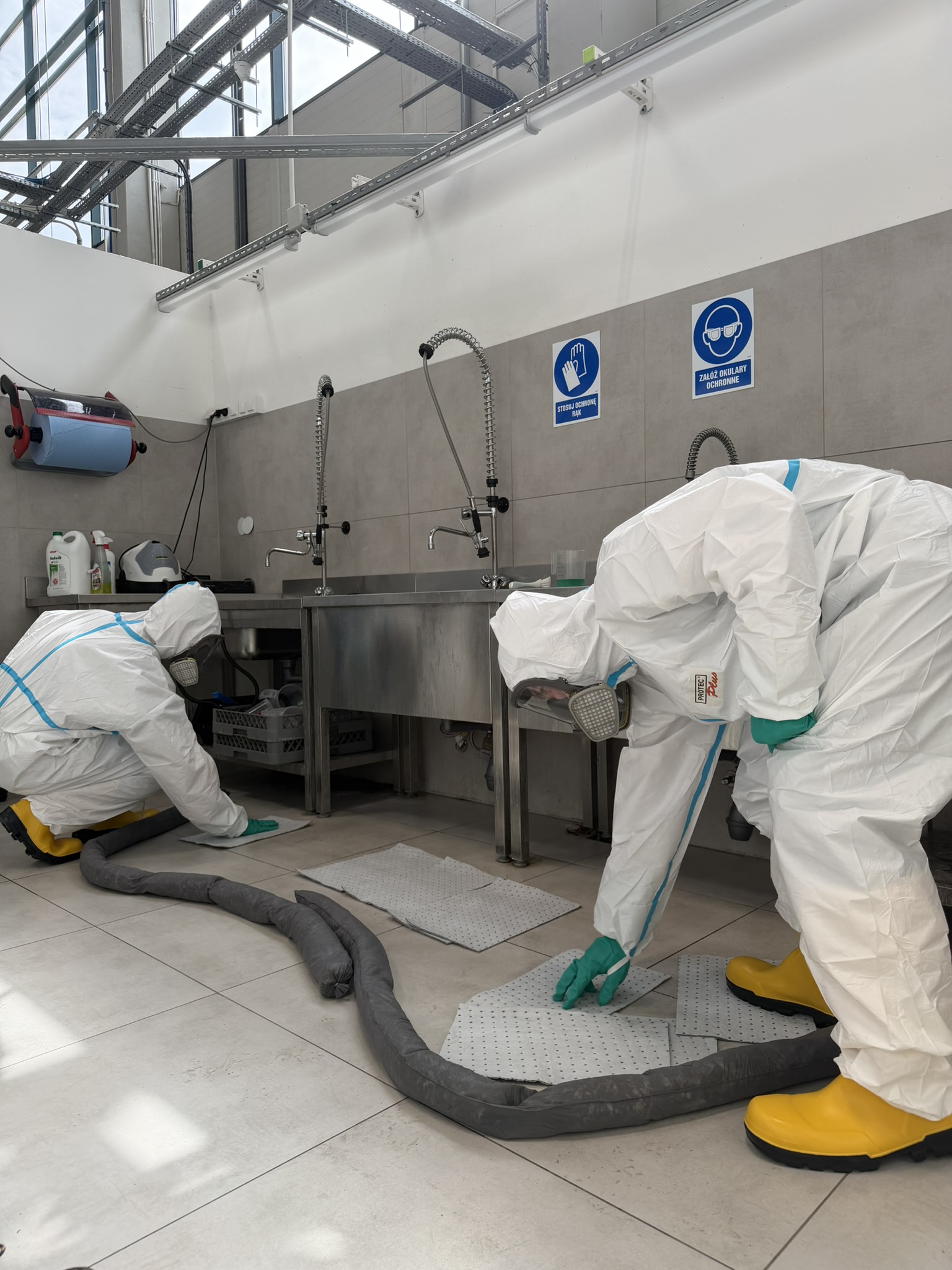
The exercises and the tasks to be performed by participants are agreed as part of the training programme. Practical exercises take the form of simulations, without deliberately releasing hazardous substances.
Spill response training can be extended to include practical preparation for responding to fire emergencies. The module covers assessing the situation, raising the alarm, principles of safe withdrawal and recognising when it is appropriate to attempt to extinguish a fire in its early stages and when to refrain from acting and call for help.
The training includes exercises in using fire extinguishers under the instructor’s supervision, in a prepared training environment. The module is not comprehensive training covering all aspects of fire safety.
The training does not include a fire safety audit, the preparation of instructions and procedures, the organisation of evacuation drills or comprehensive first aid training. ATEX, confined spaces, SEVESO major accidents and battery fires are also outside the scope described here.
The training does not replace the work of the emergency services. Recognising the limits of a safe response is part of the training.
Learning the sequence of actions, practising selected tasks and using the equipment covered by the programme. An important element is recognising situations in which participants should stop acting on their own or should not attempt to act at all.
The exercises help identify practical difficulties: unclear allocation of tasks, problems with communicating information or operating equipment. Discussing how the exercises went can provide a starting point for further improvements to the facility’s preparedness. This does not constitute a comprehensive safety audit.
After the training, participants receive certificates of attendance bearing their names.
We gather information about the facility, participants, substances used and the situations to be covered in the exercises. We agree whether the training will focus solely on spills or also include practical response to fire emergencies.
We define the programme, training duration, group arrangements and requirements for the training area and equipment.
Ecothesis coordinates the preparation of the programme and the arrangements for delivering the training. The client needs to provide information about local hazards and safety rules, appoint a contact person for organisational arrangements, ensure that employees attend and make the agreed training area available.
Before the training, we agree who will provide the equipment, protective equipment and consumables, and who will be responsible for preparing and clearing up the exercise area.
We combine theory with practice in line with the agreed programme. After the exercises, we discuss how they went and the difficulties observed.
The schedule, arrangements and price depend on:
The terms of delivery are set out in an individual quotation.
We have delivered training for manufacturing plant employees on responding to chemical spills. Extended programmes also included the practical use of fire extinguishers.
We draw on this experience when agreeing on exercises that suit the conditions and needs of each new facility.
No. Simply describe your facility’s needs, participants’ responsibilities and the situations you would like to practise. We will agree on the scope on that basis.
We agree before the training whether your equipment can be used. We need information about the equipment you have and the tasks it is intended for.
Please indicate the number of shifts and employees’ availability in your enquiry. The quotation will set out the agreed options for splitting the training into sessions, the schedule and the associated cost.
Tell us which situations you would like to practise. It is helpful to include:
You do not need to have all the details straight away — share what you already know.


